

Phototherapy based on the principles of selective photothermolysis provides primary care doctors with a safe and effective tool for treating acne, psoriasis and other skin disorders, sometimes obviating the need for toxic medications.
It can also create a much-needed new revenue stream within primary care, by allowing physicians in this sector to treat patients that they would previously have referred out to dermatologists or other specialists.
Phototherapy is actually an ancient idea. Hippocrates prescribed heliotherapy for a large range of illnesses. He understood the healing power of the sun’s light and heat. Prior to World War II, most hospitals were built with solariums, where patients could heal in the recuperative rays and warm glow of the sun.
Modern phototherapy involves the application of carefully-controlled pulses of light directly to the skin. The light is absorbed by specific chromophores (melanin, hemoglobin, water) determined by the light’s wavelength. Photothermolysis is the process of inducing a highly-targeted thermal insult by minimum light deposition into affected areas, thus leaving the surrounding tissue intact (Altshuler GB, et al. Extended theory of selective photothermolysis. Lasers in Surgery and Medicine. 2001; 29(5): 416–432).
“One of the major advantages of phototherapy when treating psoriasis and acne is that it diminishes the need for systemic medications. When used in combination with other treatment programs, it helps to enhance and accelerate results, and gives a relatively quick resolution,” explained Zehava Laver, MD, a dermatologist in Tel Aviv, and former Chief of the Dermatology Clinic at Hadassah University Hospital. Dr. Laver has extensive experience using the phototherapy technology developed by Radiancy, an Israeli company specializing in phototherapy equipment for the primary care setting.
Limits of Drug Therapy for Acne
Acne vulgaris has a prevalence of 80% among adolescents (Leyden JJ. Therapy for acne vulgaris. N Engl J Med. 1997; 336: 1156–1162), and it is one of the more common disorders among adolescents in the primary care setting, accounting for more than 2 million visits to office-based physicians per year (William DJ. Acne. N Engl J Med. 2005; 352; 14: 1463–1472). A modality to treat acne without introducing antibiotics, retinoids, chemical peels or other medication that can induce serious and prolonged side effects (Gough A, et al. Br Med J. 1996; 312: 169–172) would help ease the mind of parents, patients and practitioners.
Phototherapy is such a modality, says Dr. Laver, offering major advantages over systemic drug therapy. Apart from the fact that drug therapies require prolonged treatment periods, the therapeutic response is highly variable. Skin irritation from topical medications is the main side effect that limits their use (Zaenglein AL, Thibotout DM. Expert Committee Recommendations for Acne Management. Pediatrics. 2006; 118(3): 1188–1199).
Recent reports show an increasing proportion—up to 60%—of acne bacteria are insensitive to oral antibiotics Even when the antibiotics are initially effective, users may develop resistance at a later stage of their treatment. Moreover, antibiotic therapy must be continued for long periods of time, and even then, the remissions are short, and flare-ups may occur shortly after discontinuation of the drugs. “This has created a therapeutic void requiring an alternative solution aimed at those for whom acne has become a major medical, social and psychological issue,” said Dr. Laver.
Phototherapy & Acne Clearance
Radiancy’s Light and Heat Energy (LHE) phototherapy systems use broadband wavelength visible light (430–100 nm), along with heat to initiate a process that leads to destruction of the Propionibacterium acnes bacteria, thought to be one of the leading causes in the formation of acne lesions.
P. acnes is a slow-growing anaerobic bacteria that develop in blocked follicles and produces porphyrins as part of their normal life cycle. When exposed to light, these poryphins undergo a photodynamic reaction, resulting in the release of singlet oxygen. This then combines with the cell membrane to destroy the P. acnes in the sebaceous glands (Nitzan Y, et al. Photochem Photobiol. 2003; 192; 55: 89–96). In addition to this porphyrin excitation mechanism, LHE also utilizes visible light to target blood vessels surrounding the acne lesions and generate an anti-inflammatory effect.
Near infrared light also reduces sebum production. Directed heat reduces inflammation, soothes pain, and speeds up the reaction time and intensity of the chemical process, Dr. Laver explained.
Clinically, LHE is proving to be a highly effective acne therapy. Studies of phototherapy show over 70% or better reduction in the number of lesions after four bi-weekly treatment sessions in comparison to 20–25% clearance or reduction in lesions following treatment with topical medications for the same period of time (Elman M et al. J Cosmetic Laser Therapy. 2003; 5: 117–117. Omi T, et al. J Cosmetic Laser Therapy. 2004; 6(3): 156–162; Elman M, Lask G. J Cosmetic Laser Therapy. 2004; 6(2): 91–95). Lesion clearance can persist for as long as two months following LHE treatment.
According to Elman and colleagues, in aggregate, LHE treatment for acne in teenagers show that, “85% of the patients showed a significant quantitative reduction of at least 50% in the number of lesions after four biweekly treatments. In approximately 20% of the cases, acne lesion eradication approached 90%.” At 3 months after the last treatment, patients still maintained 70–80% lesion clearance (Elman M, Lebzelter J. Dermatol Surg. 2004; 30(2): 139–146). The authors added that LHE often delivers results in one-third the time generally expected from a standard topical or systemic drug therapy.
(For more on nutrition and natural medicines for treatment of acne, visit www.holisticprimarycare.net and read Dr. Michael Traub’s Sensitivity, Stress Reduction & Quelling Inflammation are Keys to Managing Acne.)
Phototherapy & Psoriasis Care
![]() |
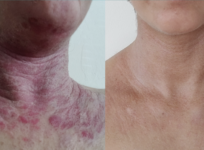
| Plantar psoriasis of the heel, before and after four weekly treatment sessions with LHE phototherapy. Photos courtesy of Prof. Ronnie Wolf, MD. |
In normal skin, the cells grow and shed at a steady, unnoticeable rate, with the entire cycle taking around 30 days. In psoriasis, this cycle is shortened to 3 or 4 days, resulting in thick plaques of shedding tissue. As these plaques thicken, blood vessels engorge to accommodate the lesion’s growth, creating areas of red, often inflamed tissue around the lesion, said Dr. Laver.
Of the many methods used to treat psoriasis, exposure to the natural rays of the sun (climatotherapy) is the oldest (Wolf R, et al. Climatotherapy: There is life in the Dead Sea. IMAJ. 2003; 5: 124–125). From there, treatment with generated UV light was the obvious next step. The major drawback to conventional UV light therapy is that the whole body must be exposed, thus increasing the risk of malignant melanoma and other forms of skin cancer (Stern RS, et al. N Engl J Med. 1997; 336: 1041–1045). This is the main limitation for UV light therapy, thus restricting the number of actual treatment sessions a patient can safely take.
Because it is applied directly to lesional areas, LHE phototherapy for psoriasis selectively pinpoints and treats damaged tissue, leaving healthy tissue largely untouched and unharmed. LHE exposes only the affected area to light and heat, thus allowing patients to avoid the risks associated with whole body UV exposure.
LHE uses a wavelength spectrum of 350–1,100 nm. The light aids in coagulating and destroying the overdeveloped capillary system that supplies the plaque with blood, oxygen and nutrients (Leviav A, et al. Dermatol Online J. 2003; 9(4)). This greatly reduces the replicative activity of the cells within the plaques, leading to resolution. The heat generated by the LHE reduces swelling and inflammation, bringing almost instant relief to the painful itching associated with psoriasis.
Leviav and colleagues studied 13 patients with plaque, palmoplantar or guttate psoriasis, who received simultaneous and parallel treatment with either LHE phototherapy plus salicylic acid–based keratolytic therapy or the salicylic acid alone. For each patient, selected lesional sites were treated with each of the two therapies. The patients received twice-weekly treatment sessions, spread evenly over 4–6 weeks. LHE phototherapy was given at a fluence of 8.6 J/cm2.
The investigators made initial PASI evaluations at baseline and again at every other treatment visit, as well as during two follow-up visits scheduled 1 and 5 weeks following the last treatment.
Among the 11 patients who completed the treatment regimen, the average global PASI score for the LHE-treated sites was reduced by 65%. In contrast, the salicylic acid-only control sites showed global PSI score reductions of only 7.4%. Six patients (55%) had score reductions of 70% or greater, and 10 patients (91%) had a 50% percent or above reduction at the LHE-treated sites. Only one patient had a poor response in the lesion treated with phototherapy (Leviav A, Wolf R, Vilan A. Dermatol Online J. 2004; 10(2): 4).
The authors note that these results are similar to those reported with pulsed dye laser in other clinical trials. However, laser therapy for psoriasis is sorely limited because the laser spot size is very small (5–10 mm), and plaque surface area is often very large. The LHE phototherapy device permits spot sizes as large as 55 mm in diameter), offering a significant advantage over lasers. The other major advantage over lasers is in terms of cost; LHE equipment is considerably less expensive than therapeutic laser systems.
In addition to objective shrinkage of psoriatic plaque size, patients often report an immediate relief of pruritus following LHE, said Dr. Laver. The clearance of psoriatic plaques was typically maintained for a 4–6 month remission period following completion of a course of treatment.
Serious adverse effects are extremely rare with LHE, she added. The treatment does generate significant erythema, but this usually resolves within 24–48 hours.
Phototherapy & Wellness-Based Care
A growing number of holistically-minded primary care physicians are finding that phototherapy is not only good for their patients with dermatologic disorders, it can also provide a much needed revenue center in their practices.
Adam Maddox, ND, a Portland, OR–based naturopathic primary care physician, first became interested in light-based therapy as an adjunctive treatment for acne. After researching different modalities, he found that pulsed broad-spectrum light systems offered the most diverse treatment options. “Now we have multiple light therapy options to address a wide range of dermatologic conditions.”
Phototherapy can be used to treat a variety of other skin conditions such as pigmented lesions and vascular lesions. It can stimulate collagen production, and it can be used for hair removal. “The ability to offer such diverse treatments expands clinic treatment options, allowing you to offer safe and effective phototherapy on many levels,” said Dr. Maddox, who has been offering phototherapy in his offices for over three years.
Given the fact that holistic practice tends to be time-intensive and many services under the holistic/naturopathic rubric are not covered by insurance, pratitioners are seeking new revenue streams to keep their clinics running.
But revenue-generating products and procedures need to be in accord with the basic philosophies of holistic and natural medicine. Some clinicians are moving into aesthetic or cosmetic therapies as a way of augmenting income, but “Botox injections and invasive surgery just don’t fit the philosophy,” said Dr. Maddox. He has found that phototherapy allows his practice to generate additional income by providing a useful therapy for genuine medical conditions. It is revenue that might otherwise be going to other practitioners.
“Since I could treat additional conditions, I was able to increase our clinic’s income by 30%,” said Dr. Maddox, “Patients were willing to pay cash for phototherapy. Now, instead of our clients going to other clinics for these treatments, they are coming to me.”