



 |
|
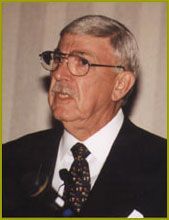
| James D’Adamo, ND, the originator of the blood type diet concept. |
BELLEVUE, WA—The surging popularity of “Eat Right 4 Your Type,” the book by Peter D’Adamo, ND, outlining the theory and practice of the so-called “blood type diets,” has a growing number of people making sudden alterations in their habitual eating patterns.
And this has James D’Adamo, ND, the originator of the blood type diet concept (and the author’s father), a little bit nervous.
“The blood types suggest reference points for what to eat in healthy individuals. The problem is, no one ever comes to us healthy. They come to us sick, and you cannot put an unhealthy person on their blood type diet,” said the elder Dr. D’Adamo, at the annual meeting of the American Association of Naturopathic Physicians. “The type diet is correct when you are healthy; it is not correct when you are not.”
Dr. D’Adamo contends that the transition toward a more correct diet should be a gradual one involving intermediary diets, time-limited and individualized use of supplements, and detoxification processes.
Both father and son are naturopathic physicians, who maintain separate practices. James D’Adamo maintains clinics in Portsmouth, NH and in Toronto; Peter D’Adamo’s clinic is in Stamford, CT.
The blood type theory—and both Drs. D’Adamo acknowledge that the concept is a theory yet to be definitively proven—posits that each of the four major blood types (O, A, B, and AB) naturally predisposes individuals to particular metabolic states and dietary requirements. If not met—and this is the case for many people—characteristic patterns of disease and discomfort emerge.
Type O, which according to transfusion literature, represents about 45% of the US population, correlates with a naturally athletic, high metabolic state and intense protein demands. “These people need flesh foods. They cannot be (healthy) vegetarians,” said Dr. D’Adamo. “They also require vigorous aerobic exercise, the longer, harder and sweatier, the better.”
The opposite pattern applies to Type A, about 40% of US adults. These individuals tend to be more intellectually or emotionally-centered, rather than physically-oriented. They can and should derive all their nutrition from vegetable sources. While capable of intense aerobic exercise for short periods, they generally do not have the endurance of Type O’s, and fare better with more contemplative forms of exercise like Tai Chi or Hatha Yoga.
The B Type, roughly 12% of the population, falls neatly in the median between the Type A and O extremes. These people tend to thrive best with a mixed diet that balances animal and plant foods. Unlike A’s, they can remain healthy on an animal protein-rich diet, and unlike the O’s, they can be healthy vegetarians. The same “best of both worlds” predisposition holds for exercise: B Types, while perhaps not as given to strenuous exercise as O’s, tend to have higher stamina than A’s. They can benefit equally from the more exertive and the more meditative forms of exercise.
The ABs, comprising about 3% of the population, tend to have the intellectual or emotional sensitivity of the A Type, though they are usually more physically hardy. They do best on a primarily vegetarian diet, though Dr. D’Adamo recommends they eat fish or some other easily digestible animal protein once or twice a week. In terms of exercise, AB’s tend to benefit more from calmer, contemplative forms rather than exertive, high-aerobic forms.
Dr. D’Adamo told his naturopathic colleagues that this framework—and it should be viewed as a general guideline, not a hard rule—developed empirically from clinical observations he made several decades ago while training in German and Swiss natural healing clinics. At the time, many naturopaths favored strict vegetarian diets for everyone.
In practice, he found that while some patients did indeed thrive on vegetarian spa regimens, others showed no improvement or showed signs of declining health and decreasing energy levels, despite diligent adherence. When these people reintroduced dairy, fish or other flesh foods—as they inevitably would—their overall health status and sense of well-being seemed to improve.
At the same time, other people at these spas and clinics obtained very clear and obvious benefits from the vegetarian diet: they lost weight, showed respiratory symptom improvements, and increased vigor after years of low grade fatigue and malaise.
Dr. D’Adamo’s search for a biological feature that might determine what sort of diet a given individual needs led him to the early work of Dr. Karl Landsteiner, the Austrian pathologist who won the 1930 Nobel Prize for identifying the four blood groups, and later, to very preliminary work by German physicians during World War II linking blood types to nutritional requirements.
Dr. D’Adamo is convinced by several decades of clinical work, that the pattern, on the whole, has validity. He outlined the framework in 1980, in his first book, “One Man’s Food … Is Someone Else’s Poison,” and further developed the concepts in “The D’Adamo Diet” (both are available by calling Dr. D’Adamo’s clinic at 603-430-7600). While the blood type diets are not exactly standard practice in modern naturopathy, the approach does have adherents.
It was not until his son Peter published “Eat Right 4 Your Type” in 1997, that the ideas really hit the nation’s kitchen counters and dining tables, spawning a minor growth industry in related books, nutritional supplements, and home testing kits.
As is the case with nearly all popular diets, the blood type approach has never been tested in an independent large-scale clinical trial. And it is unlikely to happen soon: no government agency or national institute has stepped up to fund such studies. Last November, the National Advisory Council for Complementary and Alternative Medicine—a logical source of support—sent a proposal to develop diet trials back to the drawing board.
The seeming simplicity of the blood type framework is, no doubt, part of its popular appeal. And on the surface, it provides a coherent theoretical explanation of why nearly all of the popular diets seem to benefit some individuals, though none have universal efficacy.
But James D’Adamo urged his colleagues to remember that, “books do not treat people,” and that in practice, application of the blood type concepts can be much more complex than it seems in theory.
Both he and his son have developed refinements and blood type subgroups. Peter has concentrated on differences in phenotypic expression of each genetically determined type, which reflects the level to which an individual secretes antibodies responsible for the typology. The gene coding for type is on chromosome 9q34, but expression of this gene is regulated by a separate gene. He has also done considerable research on blood type-specific digestive and circulatory responses to lectins from legumes and other plant foods.
James D’Adamo has focused on genotypic subgroups, the role of other blood proteins like the Rh factor, and variations in agglutination potential among individuals of the same basic type.
It is no simple matter to guide an ill individual with long-standing dietary habits to a different way of eating, exercising and living. “As they (your parents or guardians) fed you, so you continued to eat. And all the mistakes are integrated into your organ systems. You can’t just suddenly switch the diet.” The transition period is typically 9–15 weeks, but can be much longer in chronic illness.
In many cases, someone moving toward the more “correct” diet, will require certain vitamins, herbs, and nutritional supplements, “to bring them to a point at which the natural blood type diet can maintain them at optimum health and mental clarity.” But indiscriminate, indefinite supplement use should be avoided “Don’t give people what they don’t need. Promiscuous use of vitamins is not smart: it can cause problems rather than help them,” Dr. D’Adamo said.
Adoption of an eating pattern that corresponds to type should not be approached as “dieting,” per se. Ian Bier, ND, who practices with the elder D’Adamo, explained that “we don’t give our patients a diet plan; we give them guidelines,” which include lists of foods likely to benefit them, and those that should be avoided. “They need to figure out what they like, and how to cook those things for themselves. They leave confused, and then slowly learn what works for them.”
To learn more about the blood type diets, contact the following:
James D’Adamo’s Institute for the Advancement of Natural Therapies: www.dadamoinstitute.com; 44-46 Bridge St., Portsmouth, NH 03801. Tel. 603-430-7600.
Peter D’Adamo’s The D’Adamo Clinic: www.dadamo.com; 2009 Summer St., Suite 3, Stamford, CT 06905. Tel. 203-348-4800. Peter’s most recent book, “Live Right 4 Your Type,” as well as his previous books can be ordered.
THE REDUX: The popular “Eat Right 4 Your Type” diets propose that each ABO blood group is predisposed to particular metabolic states and nutritional needs. Type Os need animal protein, getting ill on a vegetarian diet. Type As are the opposite, doing best as vegetarians but plagued with overweight and chronic conditions on a meat-rich regimen. Type Bs can be healthy with either approach, but do best on a mixed, well-balanced diet. AB’s tend to do best on a primarily vegetarian diet, with occasional meat. The founder of the blood type concept, James D’Adamo, ND, urged a “go-slow” approach, insisting it is wrong to suddenly switch a chronically-ill person to their “proper” type diet.